
Christ and the Woman of Samaria by Pierre Mignard
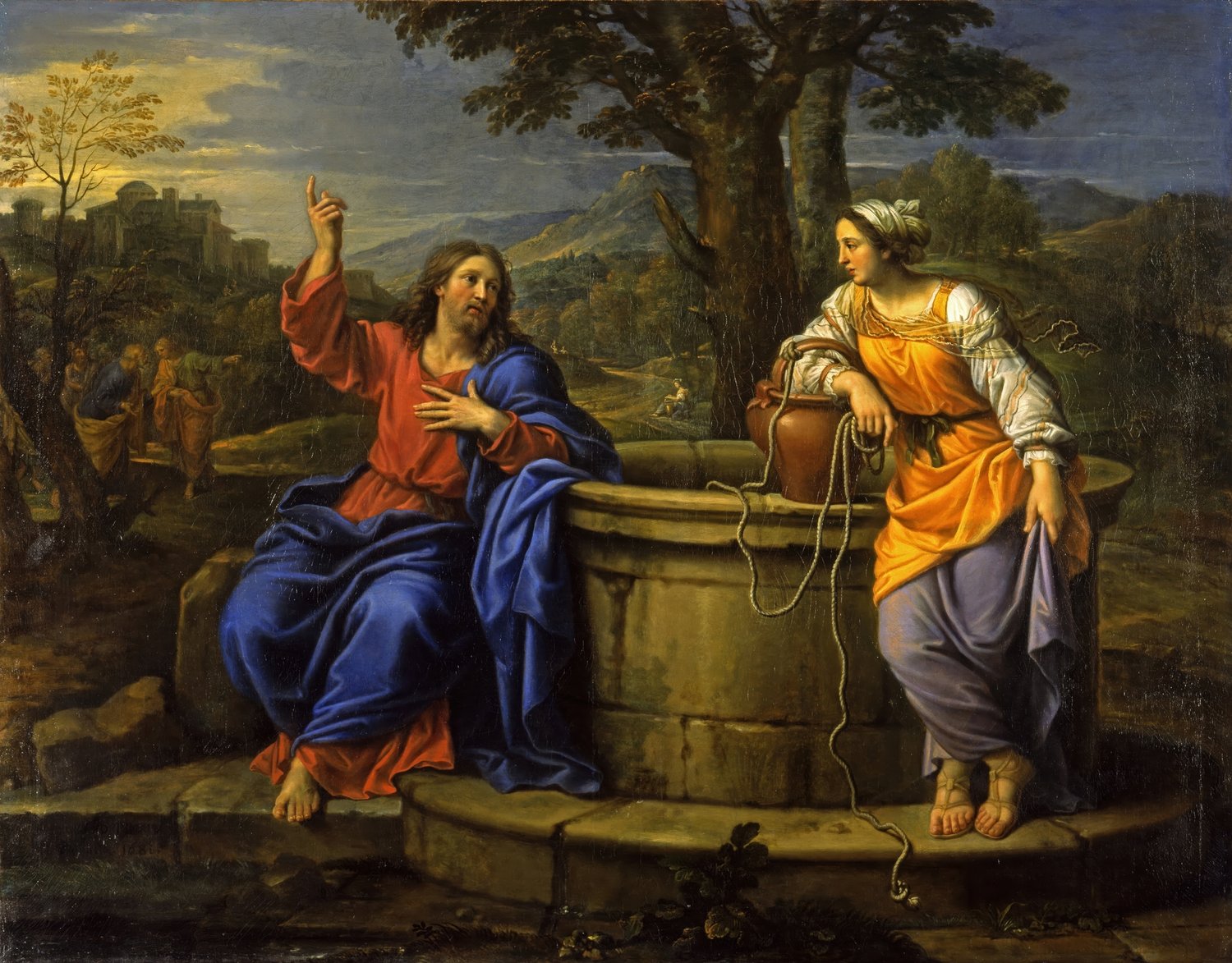
Christ and the Woman of Samaria by Pierre Mignard (1681)
Resolution: 6822 × 5337 px
This exquisite Baroque masterpiece depicts one of the most profound encounters in the New Testament: Jesus Christ's meeting with the Samaritan woman at Jacob's Well. Painted by Pierre Mignard in 1681, the work exemplifies French Classical Baroque art with its harmonious composition, idealized figures, and theological depth.
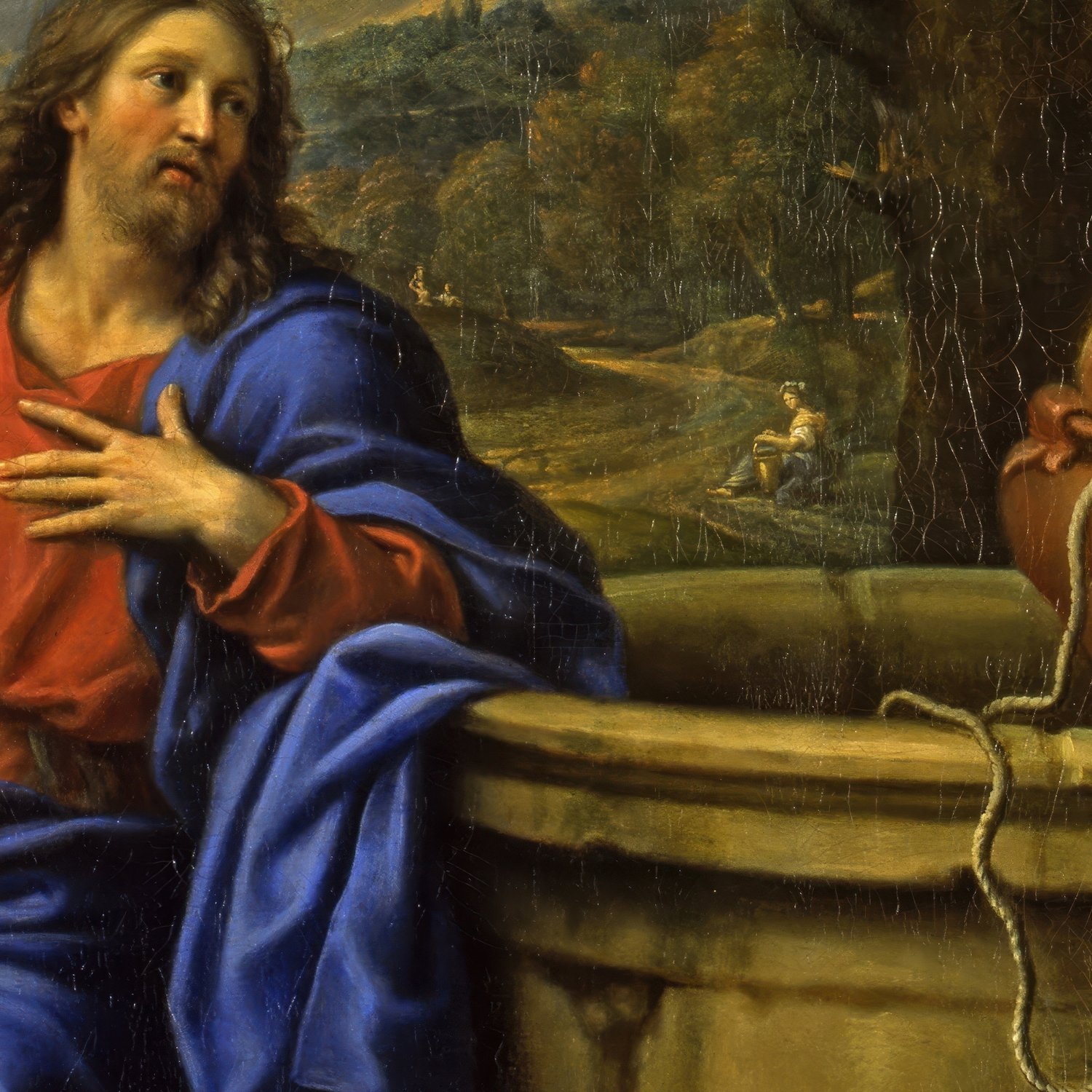
The composition centers on two figures positioned on opposite sides of the circular stone well that serves as both physical anchor and symbolic meeting point. Jesus is seated on the left rim of the well, depicted with traditional iconography: long brown hair, beard, and bare feet. He wears a vibrant red tunic beneath a sweeping blue mantle—the classic colors representing divinity and humanity. His body language is actively teaching; his right hand is raised with finger pointing upward, signifying divine truth or heaven, while his left hand rests upon his chest, indicating sincerity and the "living water" he offers in the biblical narrative from John 4:1-42.
Standing on the right, the Samaritan woman leans casually against the well, her arm resting on a large terracotta water pitcher. She is dressed in a white chemise, golden-orange overdress, and lavender skirt, with a white head covering typical of the period. Her posture is attentive as she gazes directly at Jesus, listening intently to his words about eternal life and spiritual fulfillment. A rope hangs from the jar, draping down the side of the well in an elegant curve that visually connects her to the structure.
In the middle ground to the left, three smaller figures—Jesus's disciples returning from the nearby town of Sychar—are visible. One points toward Jesus and the woman, referencing the biblical account where the disciples marvel at finding their master speaking with a Samaritan woman, as Jews and Samaritans traditionally avoided such interactions.
Mignard employs a lush pastoral landscape as the setting. A large leafy tree frames the upper right, casting dappled shade over the woman. In the background on the left, the city of Sychar appears with classical architecture. Rolling hills extend into the distance beneath a sky that transitions from soft blue to hazy golden yellow on the horizon, suggesting either the "sixth hour" (noon) mentioned in Scripture or perhaps late afternoon light.