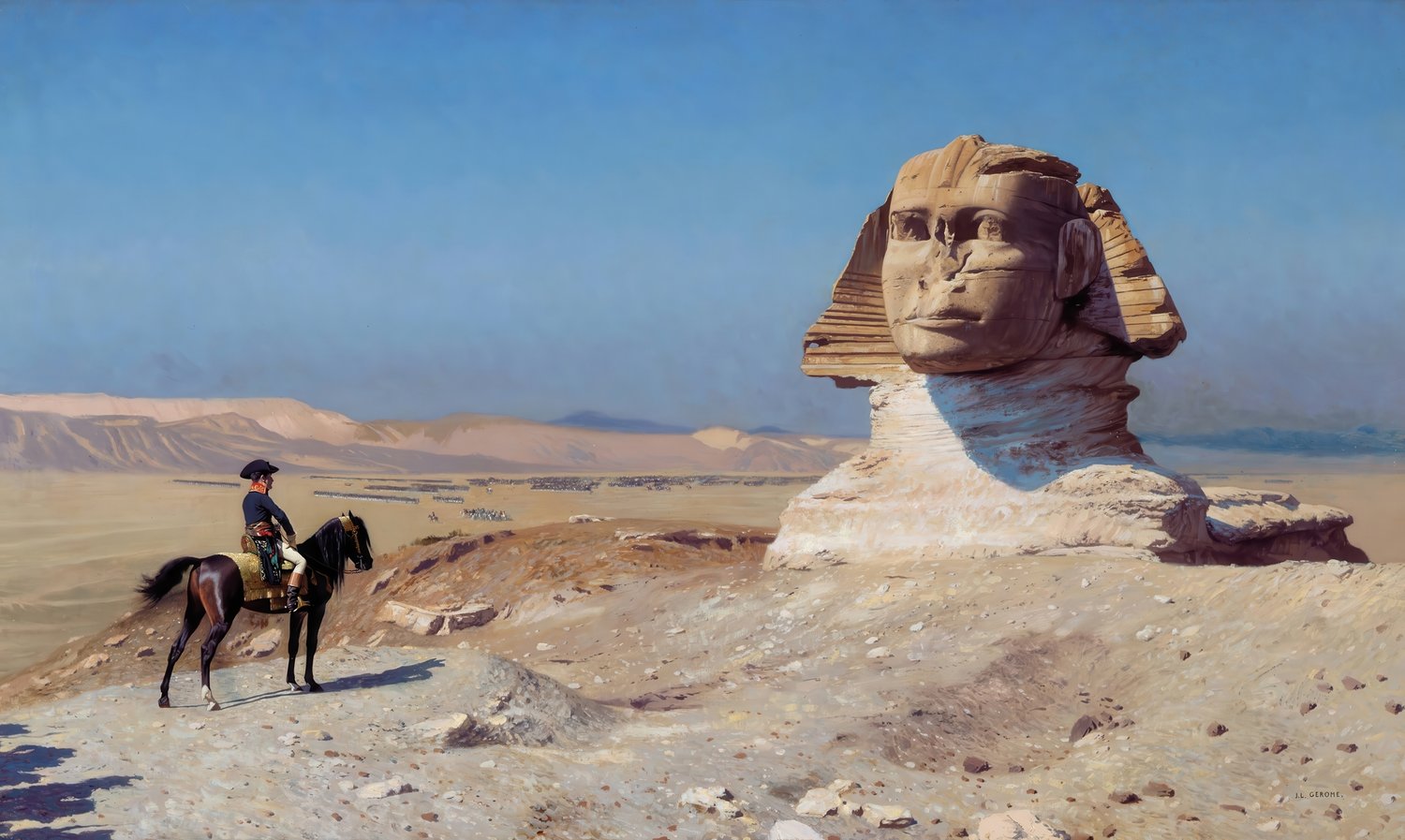
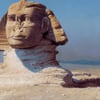
Bonaparte Before the Sphinx by Jean-Leon Gerome
Bonaparte Before the Sphinx by Jean-Leon Gerome (1886)
Resolution: 4606 × 2757 px
This dramatic Orientalist masterpiece captures one of history's most iconic encounters: Napoleon Bonaparte contemplating the Great Sphinx of Giza during his Egyptian campaign of 1798. Painted by Jean-Léon Gérôme in 1886, the work exemplifies the artist's renowned academic precision and fascination with Middle Eastern subjects.
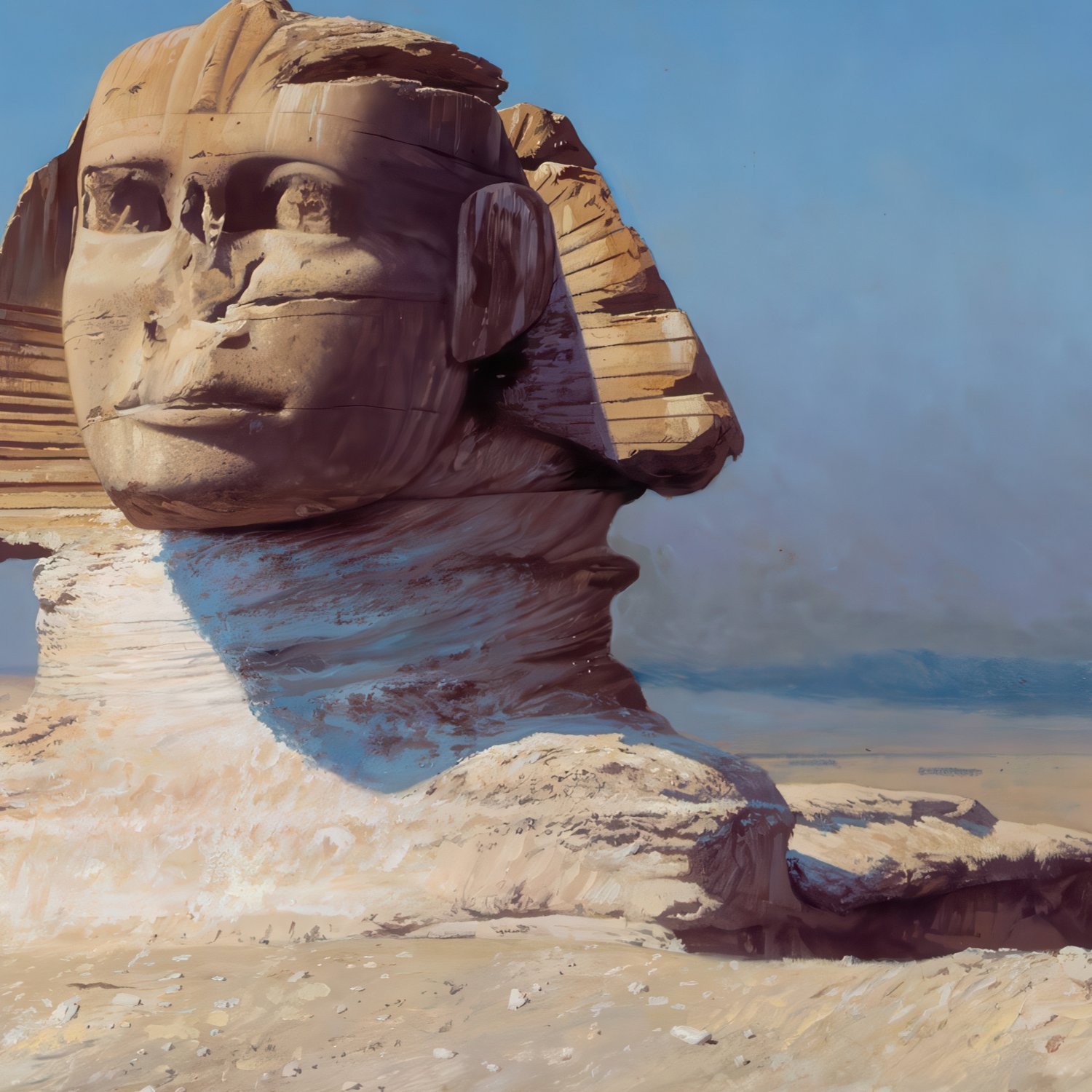
The composition presents Napoleon standing before the colossal Sphinx, whose weathered face and monumental scale dwarf the French general. The ancient monument emerges from the desert sands, its enigmatic expression gazing eternally across the Nile Valley. Napoleon, depicted in his distinctive bicorne hat and military uniform, stands in a pose of contemplation—his hand tucked into his coat in the characteristic gesture that would become synonymous with his image. Behind him, French soldiers on horseback form a protective cordon, their uniforms and weapons rendered with meticulous attention to historical detail.
Gérôme employs brilliant naturalistic lighting to convey the harsh brilliance of the Egyptian sun. The warm ochres and golden yellows of the desert landscape contrast with the cooler blues of the distant sky and the shadows cast by the monumental sculpture. The artist's signature academic realism brings both the ancient monument and the nineteenth-century figures to vivid life, creating a striking juxtaposition of temporal scales—the eternal presence of pharaonic civilization against the fleeting moment of Napoleonic ambition.
The historical context imbues this scene with profound symbolic weight. During the Battle of the Pyramids, Napoleon reportedly addressed his troops with the famous words: "Soldiers, forty centuries look down upon you." His encounter with the Sphinx represented more than mere curiosity—it was a meeting of two conquerors separated by millennia, each seeking to impose their vision upon history. Gérôme, painting nearly a century after the event, transforms this moment into a meditation on power, time, and the enduring mystery of ancient civilizations confronting modern imperial ambition.
The painting's compositional drama, archaeological accuracy, and philosophical undertones make it one of Gérôme's most celebrated works—a testament to the nineteenth century's fascination with Egypt and the Romantic allure of Napoleon's legendary campaign.