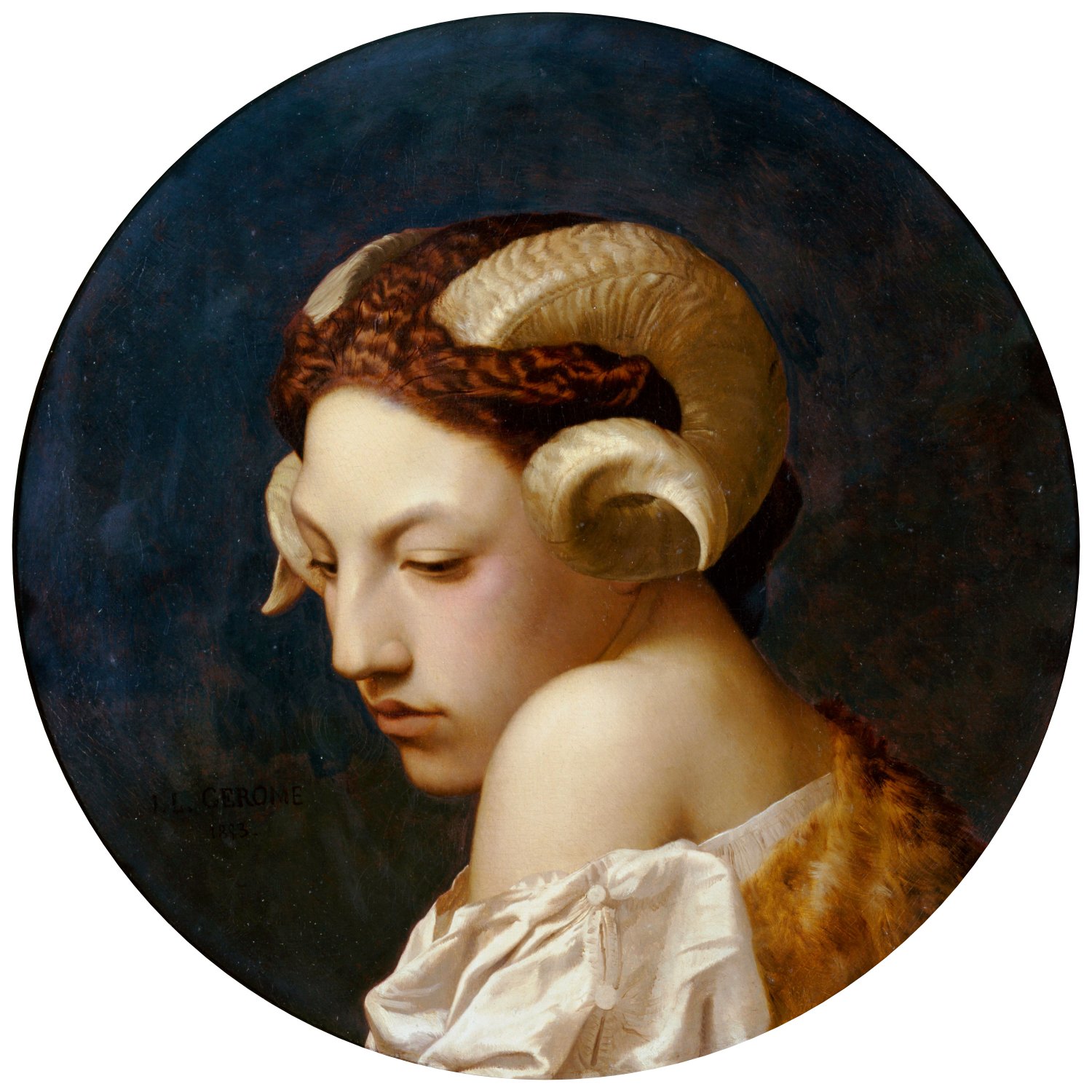
Woman's head with ram horns by Jean-Léon Gérôme
Woman's head with ram horns by Jean-Léon Gérôme (1853) French: Tête de femme coiffée de cornes de bélier
The painting "Tête de femme coiffée de cornes de bélier" ("Head of a Woman with Ram Horns") by Jean-Léon Gérôme from 1853 depicts a young woman in profile adorned with ram's horns. This work combines elements of portraiture and symbolic representation. Gérôme, known for his neoclassical style and meticulous technique, creates a mystical and captivating aura by endowing the woman with animalistic traits.
Gérôme’s painting is characterized by fine brushwork and gentle modeling of facial features, giving the piece a strong sense of plasticity. The dark background establishes a calm, almost meditative atmosphere, highlighting the bright, almost flawless face of the woman. Gérôme’s use of light and shadow adds depth to the depiction, accentuating the contrast between the softness of the human face and the ruggedness of the horns.
Ram’s horns carry symbolic meanings across various cultures—often representing strength, power, or even ferocity. The combination of these attributes with the woman's gentle expression creates a sense of tension and could be interpreted as an expression of the interplay between strength and gentleness. The horns might also be a mythological allusion, possibly referencing Greek or Roman goddesses or the figure of Pan in ancient art.
Resolution 10 000 x 10 000 px