
Jesus and Peter on the Water by Gustave Brion
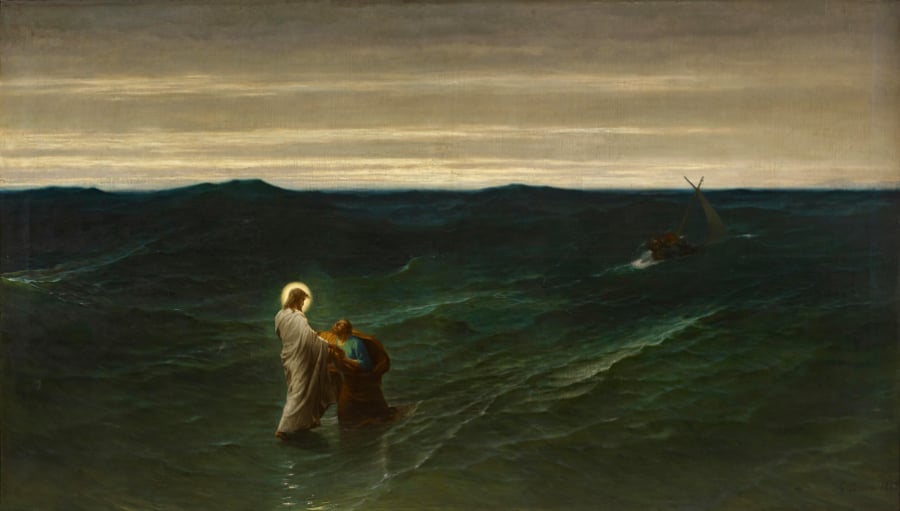
Jesus and Peter on the Water by Gustave Brion (Jesus et Pierre sur les Eaux, 1863)
Gustave Brion’s Jesus et Pierre sur les Eaux (1863) is one of the most powerful 19th-century interpretations of the Gospel episode recounted in Matthew 14:22–33, in which Peter, at Jesus’ invitation, steps out onto the stormy Sea of Galilee, only to begin sinking when his faith falters. At the critical moment, Christ reaches out and grasps his disciple’s hand in an act of immediate rescue.
Painted in a sombre, dramatically realistic style typical of the French artist – who was renowned for his historical and religious subjects – the canvas plunges the viewer into the heart of the tempest. The sea is rendered as a monumental, almost apocalyptic force: towering black-green waves dwarf the two solitary figures and threaten to swallow them whole. Far in the distance, the faint silhouette of the disciples’ boat appears as a tiny, helpless speck, heightening the sense of isolation and peril.
Light plays a decisive symbolic role. Almost all illumination is concentrated on the figure of Christ, whose calm, upright form glows softly against the surrounding darkness. He stands as the sole fixed point amid the chaos – serene, unshaken, and radiant – while Peter, half-submerged and desperately stretching upward, embodies human frailty and wavering trust.
Through this stark contrast between divine composure and human panic, Brion transforms a familiar biblical miracle into a profound meditation on doubt, faith, and salvation. In a single outstretched hand, the painting captures the essence of the story: the moment when fear is conquered by grace. Widely regarded as one of the most emotionally gripping depictions of the “Walking on Water” episode, Jesus et Pierre sur les Eaux remains a masterpiece of religious realism that continues to move viewers more than a century and a half after its creation.
Resolution 7524 x 4274 px