Ocean Life by James M. Sommerville and Christian Schussele
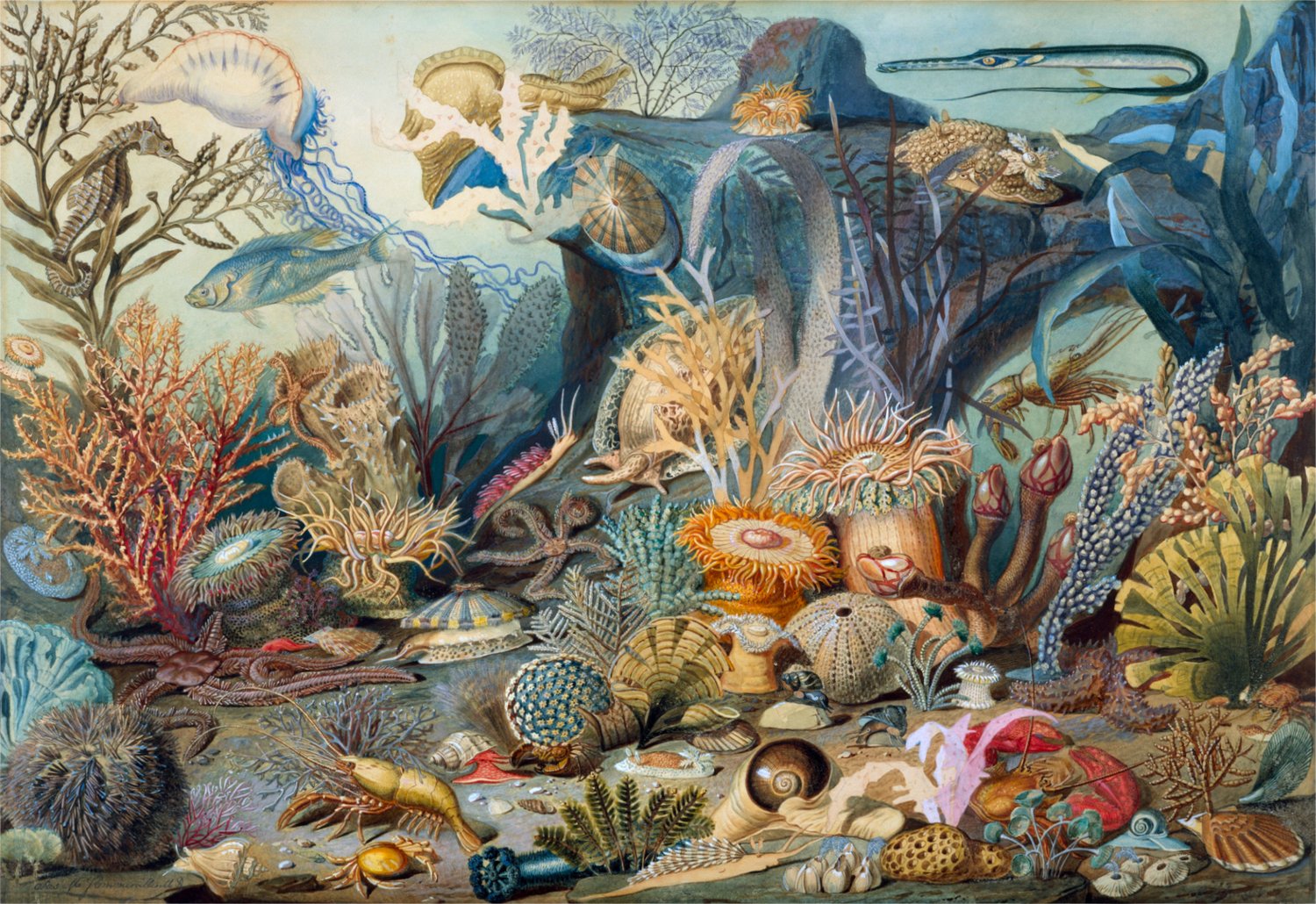
Ocean Life by James M. Sommerville and Christian Schussele (ca. 1859)
This vibrant mid-19th-century watercolor, titled Ocean Life, presents a richly detailed and imaginative underwater panorama teeming with marine specimens. The composition is densely packed yet carefully arranged in a quasi-naturalistic tableau: a rocky underwater landscape rises in the center, forming a dramatic backdrop of deep blues, greens, and shadowy crevices. From this central reef-like formation cascade and spread an extraordinary variety of sea creatures and plants, creating an almost encyclopedic display.
Foreground elements include spiny sea urchins, crawling crabs, a large conch shell, brilliantly colored starfish, sea anemones with extended tentacles, branching red and orange corals, seaweeds swaying in implied currents, lobsters, shrimp, seashells in spiral and fan shapes, and delicate clusters of marine flora. Midground and background feature jellyfish floating with translucent bells and trailing tentacles, schools of small fish darting through the water, seahorses clinging to gorgonian corals, a pipefish or needlefish gliding near the top, sea fans, sponges, and more exotic invertebrates like sea cucumbers and possibly early representations of nudibranchs or similar forms. The palette is luminous and varied—soft blues and aquas for the water, warm oranges/reds/pinks for corals and anemones, golden yellows and deep greens for algae and fish—heightening the sense of wonder and biodiversity.
Stylistically, the work blends scientific illustration with artistic romanticism typical of the Victorian era. Executed in watercolor, gouache, graphite, and gum arabic on paper, it displays precise, almost miniaturist rendering of textures (spiny surfaces, translucent jellyfish bells, intricate shell patterns) while allowing fluid, painterly washes for the watery atmosphere and subtle gradations of light filtering through the ocean depths. The arrangement is not strictly realistic but follows the tradition of 18th- and 19th-century natural history compositions (similar to Ernst Haeckel’s later plates or Audubon-style aggregations), where specimens are artfully grouped for maximum visual impact and educational clarity rather than depicting a single coherent ecosystem slice.
Resolution 7500 x 5100 px