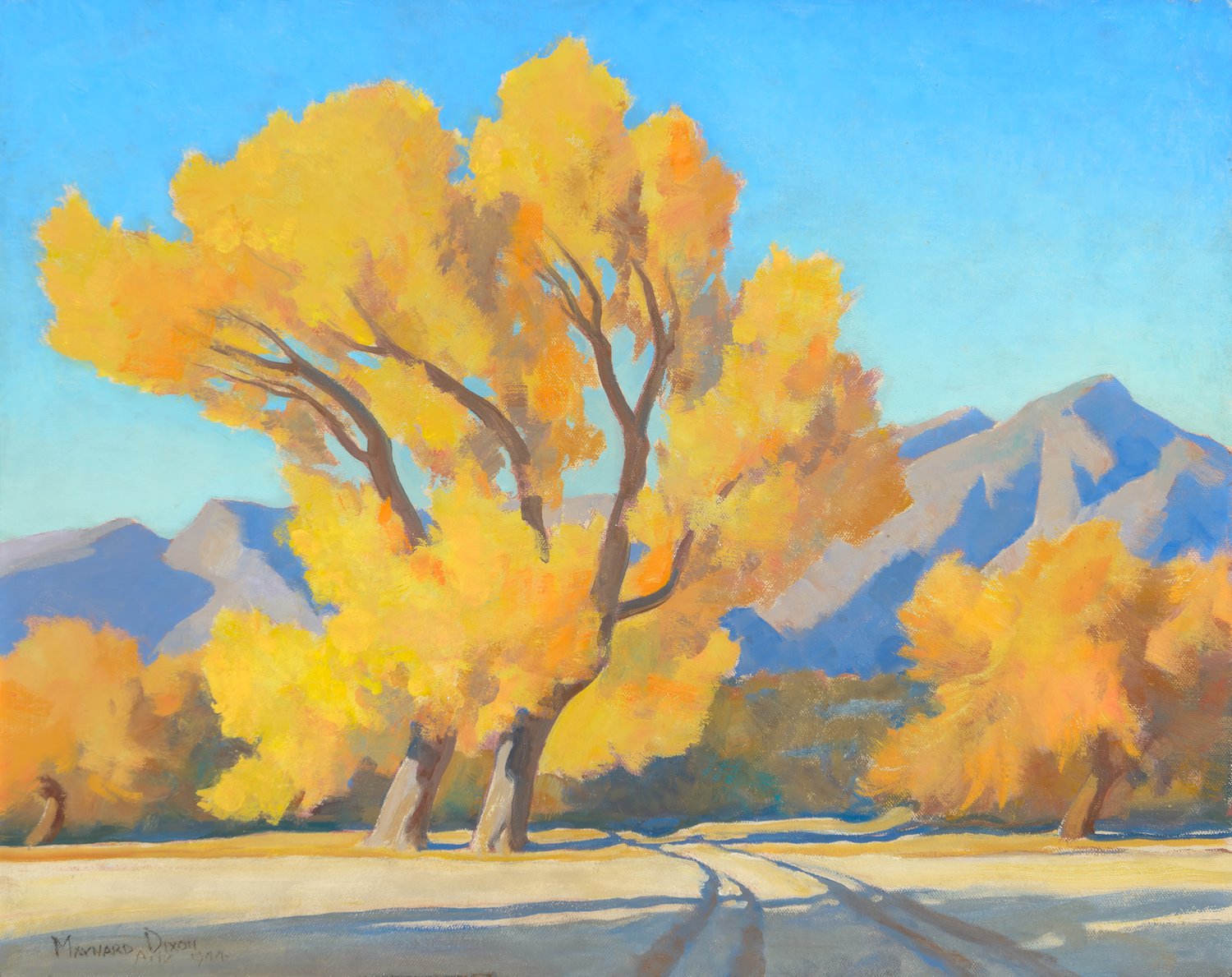

Desert Cottonwoods Arizona by Maynard Dixon
Desert Cottonwoods Arizona by Maynard Dixon (1944)
Resolution: 7611 × 6034 px
This magnificent painting stands as a quintessential example of American Western art and the mature style of Maynard Dixon, one of the most celebrated painters of the American Southwest. Created in 1944 during the final period of Dixon's life, the work captures the serene beauty of an Arizona autumn with masterful simplicity and profound atmospheric sensitivity.
The composition depicts a sun-drenched desert scene centered on a cluster of cottonwood trees—remarkable indicators of water in an otherwise arid landscape. These riparian giants dominate the mid-ground, their branches reaching upward and outward, filled with dense foliage blazing with autumn colors. In the foreground, a pale sandy road or dry riverbed stretches across the bottom third of the canvas, with faint ruts leading the viewer's eye from center toward the middle distance, suggesting a path traveled but currently empty. Behind the trees, rugged mountains rise with softened edges that suggest atmospheric perspective and great distance. Above all, a vast expansive sky emphasizes the openness characteristic of the desert environment.
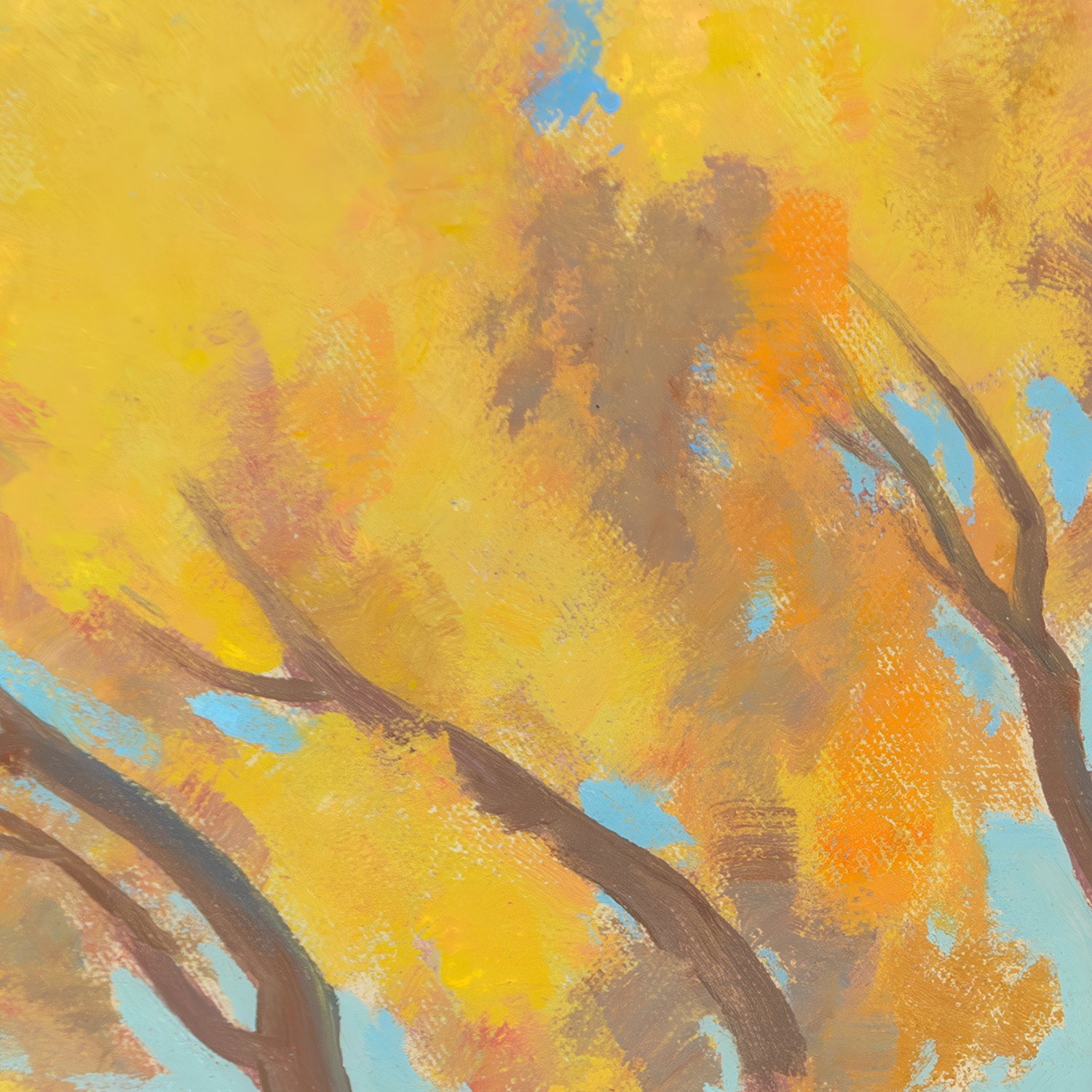
Dixon employs a striking complementary color scheme that creates remarkable vibrancy and contrast. The cottonwoods burn with cadmium yellow, gold, ochre, and soft orange—signaling autumn's arrival when desert cottonwoods turn brilliant before dropping their leaves. Against this warmth, cool blues, lavenders, and purples dominate the background. The mountains appear in hazy blues and grays, contrasting sharply with the hot yellows of foliage, while the sky stretches above in clear, bright cerulean blue. Earth tones of pale cream, beige, and light tan represent the dry dusty Arizona soil, while dark browns and near-blacks define tree trunks and ground shadows, anchoring the composition visually.
The painting exemplifies Dixon's mature modernist approach to Western landscape through simplification of form. He does not render every individual leaf but instead uses broad, flat brushstrokes to suggest the mass and volume of foliage. Mountains become simplified geometric planes of light and shadow. The emphasis rests on capturing the feeling of Arizona light rather than topographical accuracy—the harsh, bright sun creating distinct, sharp shadows on the ground.