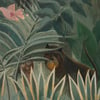
The Equatorial Jungle by Henri Rousseau
The Equatorial Jungle by Henri Rousseau (1909)
Resolution: 4137 × 4506 px
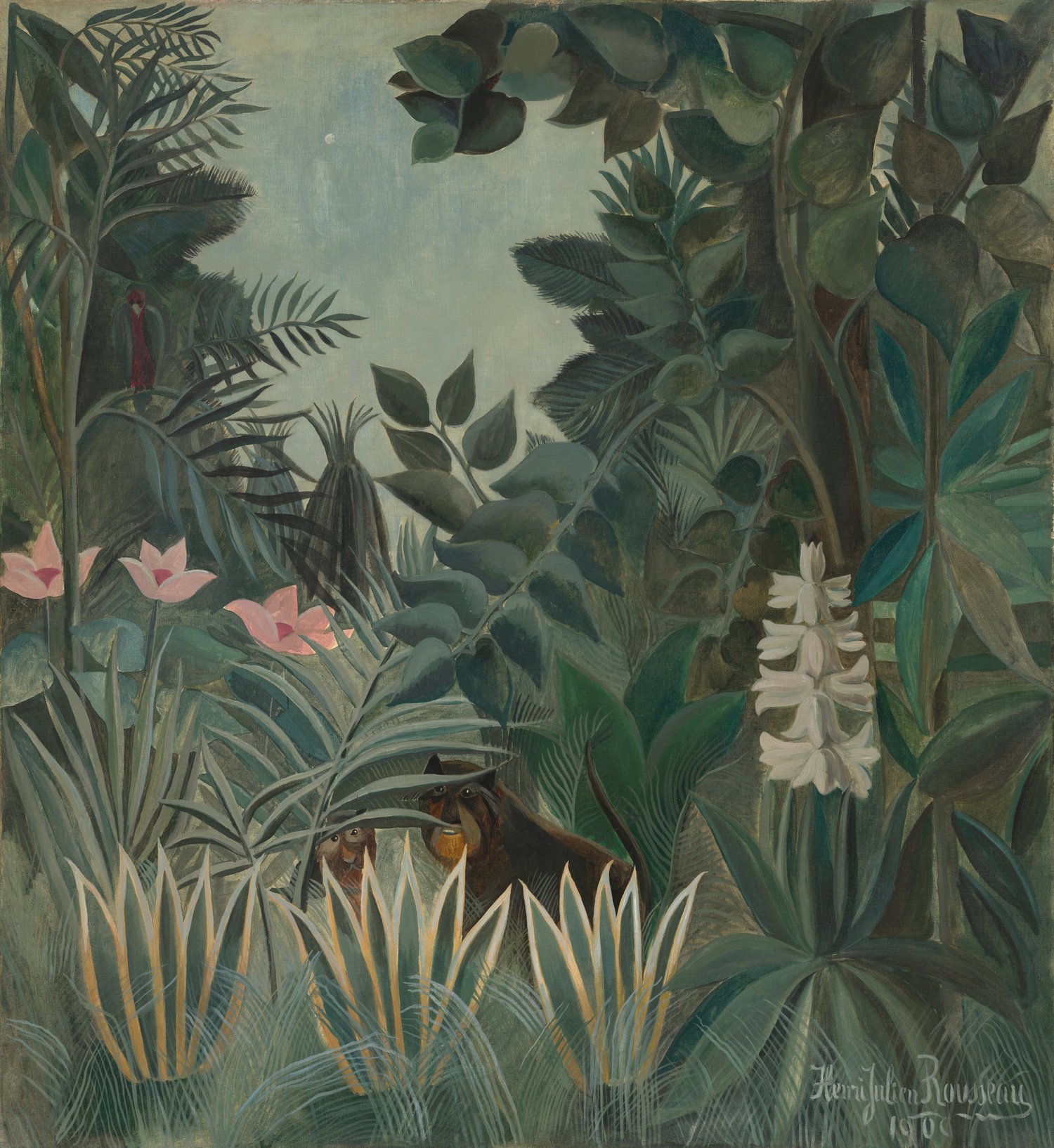
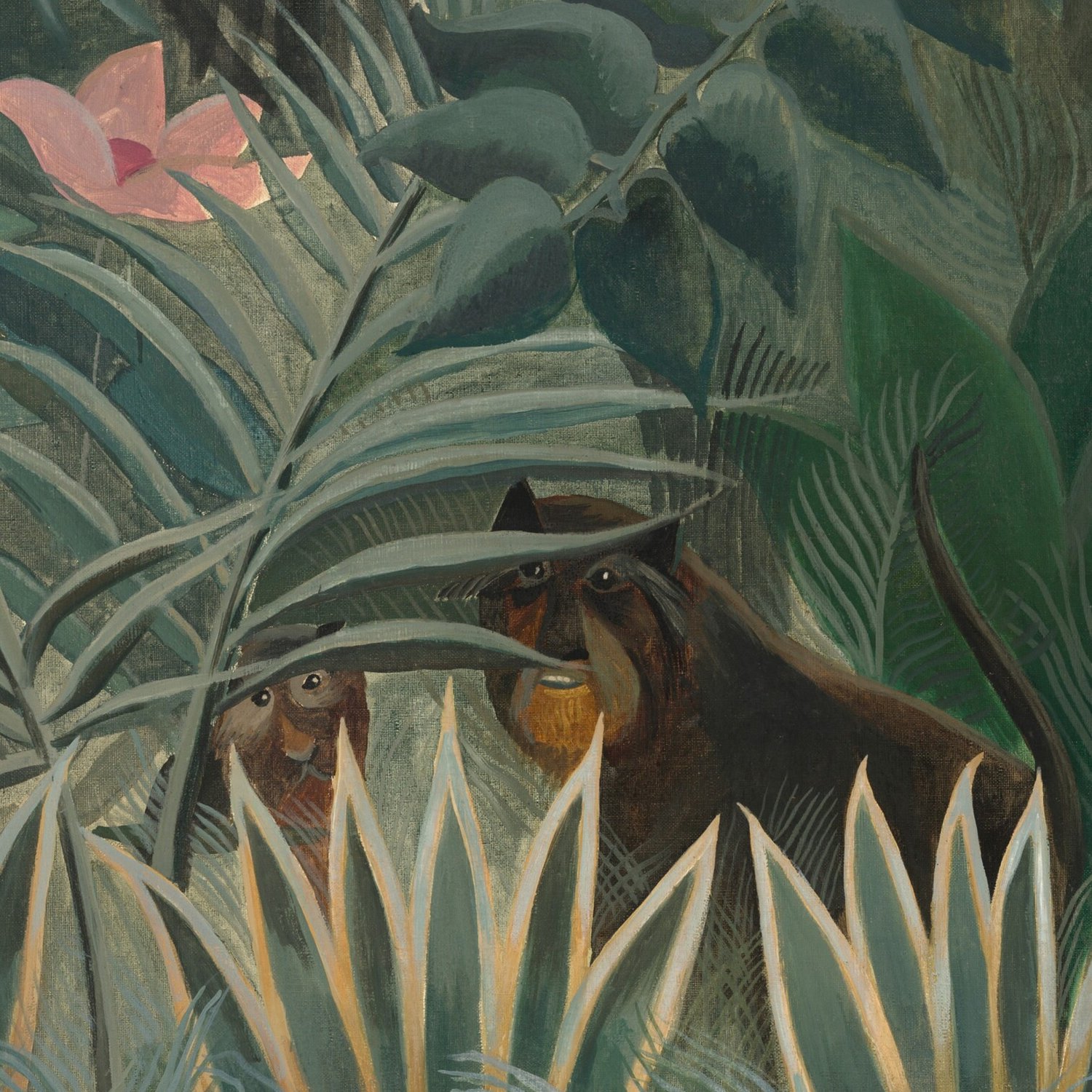
Henri Rousseau’s The Equatorial Jungle presents a dense, theatrical world of overlapping palms, broad leaves, flowers, and grasses. Two animals peer from the undergrowth near the lower center, while a slender red bird and clusters of pink and white blossoms punctuate the layered field of green.
Signed and dated 1909, the painting was not based on direct travel to the tropics. Rousseau built his imagined jungles from observations made in Parisian botanical gardens and zoos, together with printed illustrations and his own invention. Flat planes, crisp silhouettes, repeated leaf patterns, and compressed depth turn the landscape into an intricate decorative screen that rewards slow looking.
The work is significant because Rousseau transformed secondhand visual sources into a radically personal pictorial world. His deliberate simplification and dreamlike spatial logic challenged academic naturalism and helped secure his importance for the early twentieth-century avant-garde. The partially concealed animals intensify the sense of mystery, making vision itself—what can be seen, hidden, or imagined—a central subject of the painting.
This high-resolution artwork preserves the two watchful animals, vivid flowers, red bird, layered tropical foliage, cool green palette, flattened forms, subtle surface texture, and distinctive signature of Rousseau’s late jungle masterpiece.