Color Wheel by Johann Wolfgang von Goethe
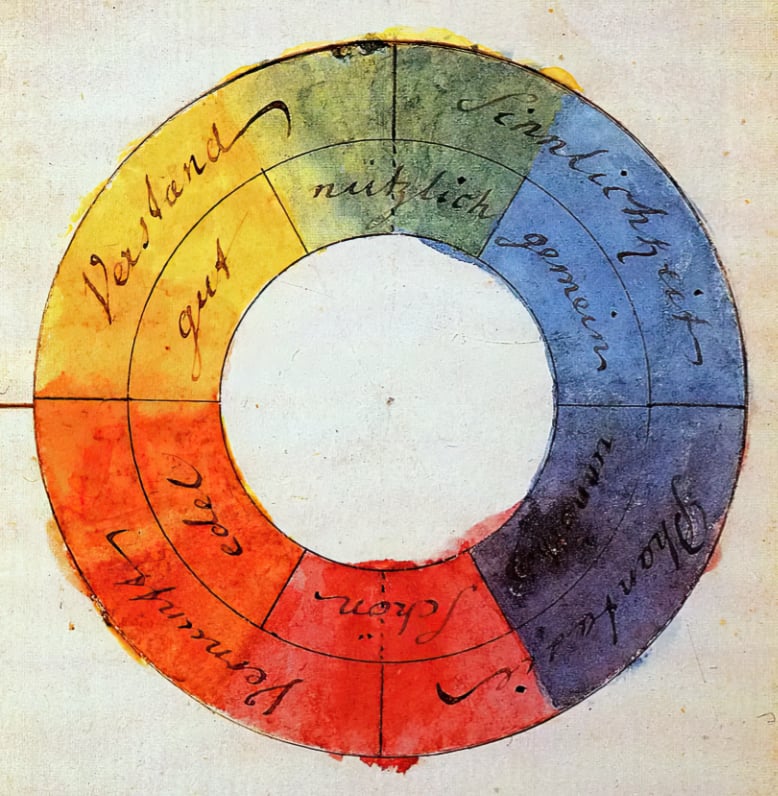
Goethe’s Color Wheel for the Symbolization of the Human Mind and Soul (1809)
The image shows a hand-painted, ring-shaped color wheel by Johann Wolfgang von Goethe, who was not only a renowned poet but also a passionate natural scientist. This work is part of his studies on color and dates back to 1809. It is more than just a color diagram – it is a symbolic representation of psychological, ethical, and spiritual ideas that Goethe associated with colors.
Form and Structure
The wheel consists of six color segments, arranged in an outer and inner ring. The colors are not distributed evenly but blend into one another in a painterly fashion. The sequence begins in the upper left with a warm yellow and proceeds clockwise through green and blue tones to red.
Colors and Associated Terms
Goethe assigned specific character traits, emotional states, or moral concepts to each color. These terms are handwritten in calligraphy within the outer ring:
- Yellow (upper left): Verstand (“intellect”) – symbolizes reason and clarity.
- Yellow-green: gut (“good”) – associated with usefulness.
- Green: nützlich (“useful”) – conveys balance and objectivity.
- Blue-green: gemein (“vulgar”) – negatively connoted, unrefined.
- Blue: Sinnlichkeit (“sensuality” or “sensory”) – seen here in a somewhat passive or darker sense.
- Blue-violet: phantastisch (“fantastic”) – imaginative, dreamlike.
- Red-violet: ernst (“serious”) – depth of feeling and seriousness.
- Red: schön (“beautiful”) – beauty as an ideal.
- Orange-red: edel (“noble”) – expressing elevation and dignity.
- Orange: Temperament – lively, fiery energy.
The color tones form a kind of spectrum, with warm colors (red, orange, yellow) symbolizing positive, active, and intellectual traits, while cool colors (blue, violet) are associated with passive, dark, or irrational qualities.
Interpretation
Goethe did not view color merely as a physical phenomenon, but as an expression of inner human states. His color wheel is thus psychological and symbolic, standing in contrast to the purely physical theory of color by Isaac Newton. While Newton analyzed light into measurable spectral components, Goethe was more interested in the emotional and perceptual effects of color on the human mind.
The wheel suggests that a balance is possible between the intellectual (yellow) and the imaginative (blue) poles – represented by harmonious green. At the same time, the link between red and violet illustrates the depth of emotional life. For Goethe, colors are carriers of meaning, ethics, and soul.
Resolution: 3200 x 3300 px